MCSplat: Multi-View Photometric and Geometric Consistent Feed-Forward Gaussian Splatting for Driving Scenes NeurIPS2026
1 Shanghai Research Institute for Intelligent Autonomous Systems, Tongji University
2 Zaofu Intelligent Technology Co., Ltd.
3 College of Automotive and Energy Engineering, Tongji University
4 Institute of Automation, Chinese Academy of Sciences5 SAI, Shanghai Jiao Tong University
Abstract
Driving-scene reconstruction via feed-forward Gaussian splatting from sparse multi-view images remains challenging due to two factors. First, cross-camera photometric inconsistency, caused by variations in exposure, ISP, and illumination, can be incorrectly absorbed into Gaussian geometry. Second, unreliable local geometric supervision arises from normal-based constraints near depth discontinuities.
To address these issues, we present MCSplat, a multi-view consistent feed-forward Gaussian splatting framework for driving scenes. MCSplat constructs a canonical appearance space from depth-guided multi-camera correspondences to decouple geometry learning from camera-specific appearance. A multi-scale Bilateral Grid Transformer restores raw camera appearance from canonical renderings, enabling photometric supervision without contaminating Gaussian geometry. To improve local geometric reliability, we estimate Fisher-information-based uncertainty from photometric sensitivity and use it to adaptively weight surface-oriented self-supervision. Extensive experiments on Waymo and nuScenes demonstrate improved image reconstruction quality and generalization across driving datasets. Geometry-oriented evaluations further reveal enhanced cross-view depth consistency and local surface-normal agreement, while qualitative results show fewer geometric artifacts and more coherent structures across overlapping views.
Method overview
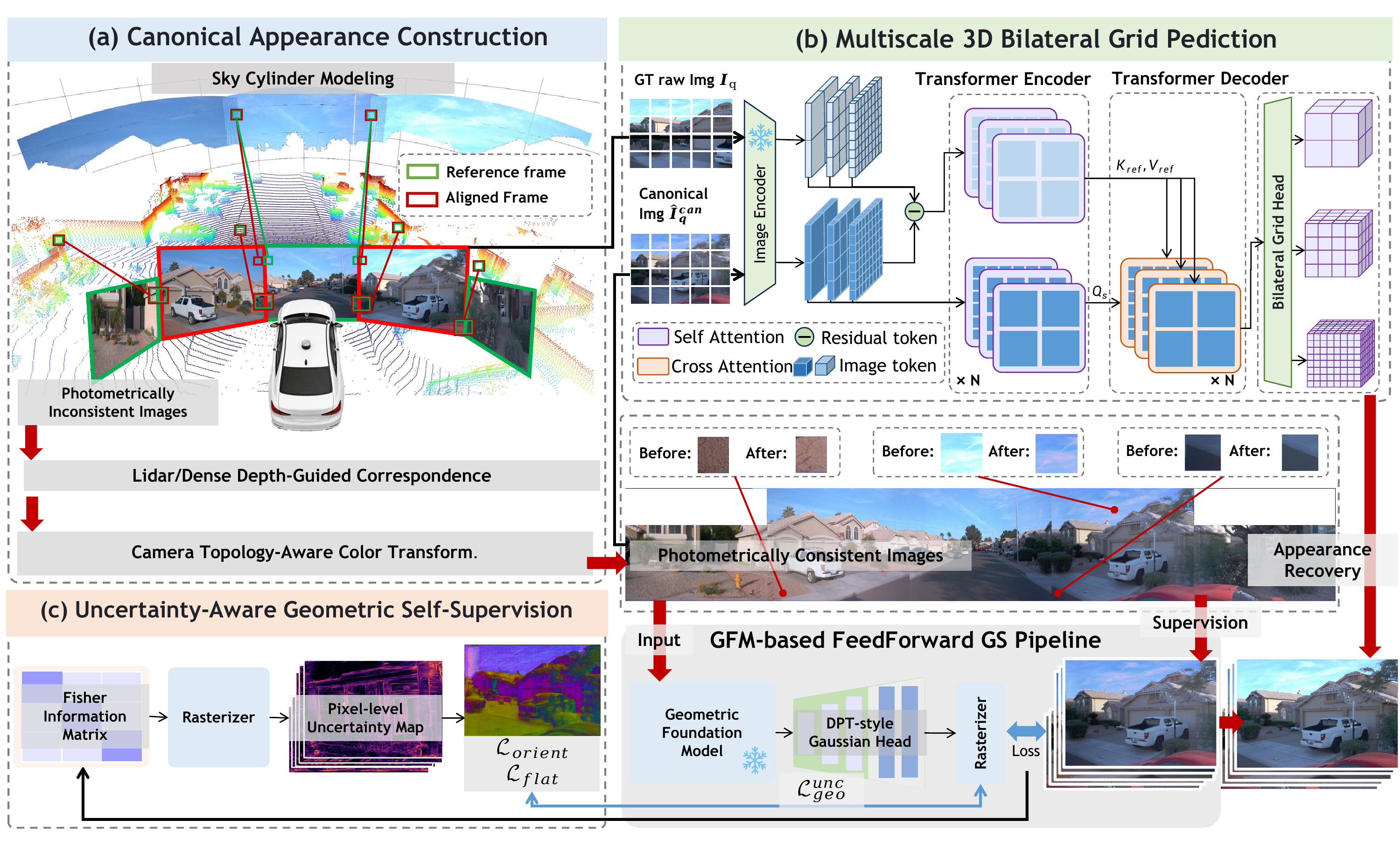
Explore the results
Interactive results
Interactive appearance comparisons, 3D Gaussian reconstructions, and cross-lane novel views.
Appearance consistency
Bilateral Grid Transformer
Drag the divider (or use the toggle) to compare the same reconstruction in canonical appearance space (BGT off) versus after bilateral-grid correction (BGT on). Ground truth is shown above for reference.
Gaussian reconstruction
UniSplat vs MCSplat in 3D
Loading SuperSplat…
Loading SuperSplat…
Tip: hover a viewer and press F to frame · drag to orbit · scroll to zoom · right-drag to pan
Loading Gaussian scenes…Novel-view synthesis
Cross-lane novel-view synthesis
Citation
@article{wang2026mcsplat,
  title={MCSplat: Multi-View Photometric and Geometric Consistent Feed-Forward Gaussian Splatting for Driving Scenes},
  author={Wang, Yifei and Tian, Wei and Bao, Wenhua and Zhou, Jia and Wang, Hanshi and Ge, Fudong and Wu, Jianhua and Yuan, Shuai and Zhang, Zhipeng and Liu, Xingliang and others},
  journal={arXiv preprint arXiv:2610.25345},
  year={2026}
}
Acknowledgement
This work was supported by the Fundamental and Interdisciplinary Disciplines Breakthrough Plan of the Ministry of Education of China (Grant No. JYB2025XDXM123), the Science and Technology Commission of Shanghai Municipality (Grant No. 25ZR1401356), the Shanghai Municipal Science and Shanghai Automotive Industry Science and Technology Development Foundation (Grant No. 2601), the National Key R&D Program of China (Grant No. 2024YFE0115400), the National Natural Science Foundation of China (Grant No. 62273256), and the Jiangxi Provincial Major Science and Technology Special Project (Grant No. 20262ABE010004). We are particularly grateful to Zaofu Intelligent Technology Co., Ltd. for its valuable support.